


The Anatomy of Industrial Hardware Failure: Root Causes, Metallurgy, and High-Performance Replacements
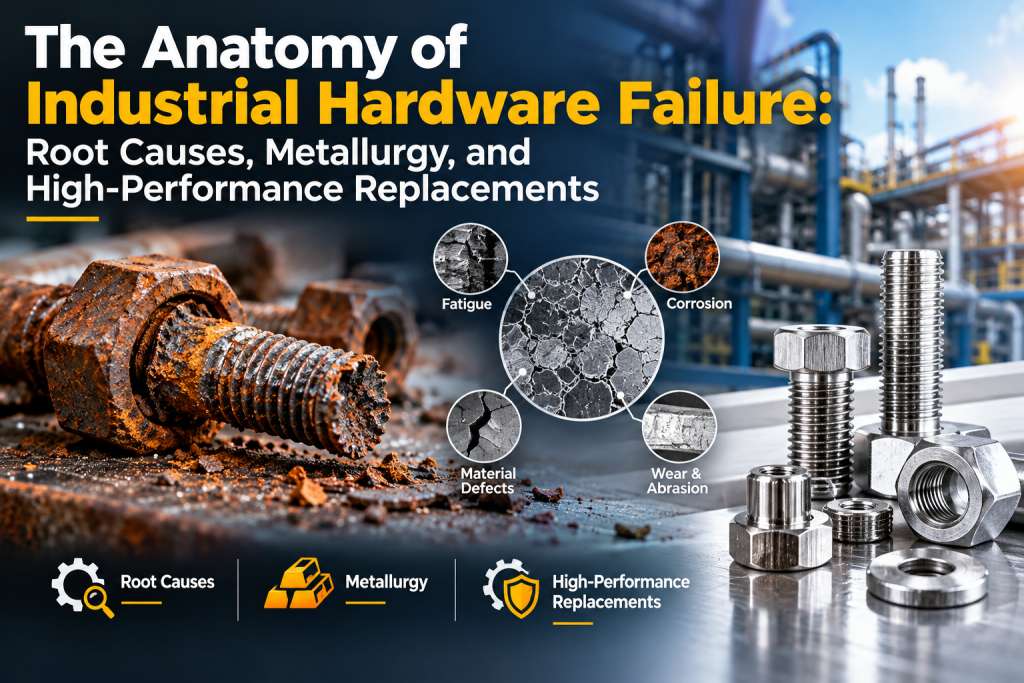
In heavy manufacturing, oil extraction, and continuous fabrication facilities, mechanical breakdown is rarely sudden. It is almost always cumulative. Long before an electric motor trips or a primary conveyor stops, microscopic friction, thermal cycling, and cyclic tension begin degrading individual components.
A roller drive link stretches under uneven mechanical pull. An electric motor bearing experiences microscopic surface pitting due to contaminated lubricant. A threaded pipe fitting develops stress-corrosion microcracks from constant fluid pressure spikes.
When these components finally give way, the failure is often blamed on unexpected load surges. However, forensic maintenance analysis shows that over 70% of premature machine breakdowns trace back to improper metallurgy, incorrect component selection, and sub-standard hardware.
Understanding how industrial components wear out at a mechanical level allows plant engineers and procurement teams to address structural vulnerabilities before they cause costly downtime.
Below is an engineering analysis of why essential industrial hardware fails under heavy plant duty, the material science required to prevent breakdown, and how genuine parts from HemShiv Enterprise maintain continuous operational integrity.
1. Power Transmission Fatigue: The Dynamics of Roller Chain and Chain Lock Failures
Roller chain drives are the mechanical workhorses of automated manufacturing, bucket elevators, and bulk material handling systems. Despite their rugged appearance, roller chains operate under complex mechanical forces, including dynamic tensile pull, centrifugal flinging, and impact shock as rollers seat into sprocket teeth.
The Mechanics of Master Link Rupture
In continuous industrial drive loops, over 80% of unexpected chain separations occur at the connection point: the chain lock (master connecting link).
| Failure Mode | Physical Manifestation | Root Engineering Cause | Metallurgical Solution |
| Pin Shear Failure | Connecting pins snap flush at the link plate | Severe mechanical shock load or sudden jam | Heat-treated alloy steel core with high ductility |
| Fatigue Plate Fracture | Clean, flat crack across the eyelet hole | Cyclic tensile stress exceeding fatigue endurance | Shot-peened, carbon-alloy side plates |
| Pin Galling / Scoring | Severe metallic wear and seizure on pin barrel | Lubrication starvation and abrasive dust ingress | Induction-hardened surface layer (60+ HRC) |
| Clip Disengagement | Retention spring clip slips off in motion | Loose tolerance fit or side-plate interference | Precision-formed, spring-steel retaining clips |
Why Metallurgy Matters in an Industrial Chain Lock
A generic, low-grade chain lock is often stamped from mild commercial sheet steel without controlled heat treatment. Under cyclic dynamic loads, the pin holes elongate, creating loose tolerances. This looseness leads to uneven pin loading, accelerated bushing wear, and sudden chain breakage.
High-performance roller chain links utilize alloy steels enriched with chromium and manganese. The pin barrels undergo precision induction hardening, giving them an ultra-hard exterior to resist wear while maintaining a tough inner core capable of absorbing cyclic shock loads without snapping.
Plant operators sourcing certified simplex, duplex, and triplex connecting links can inspect technical pitch tolerances directly via the HemShiv Industrial Hardware Store.
2. Rotational Tribology: Why Motor Bearings Fail and the SKF Advantage
Bearings represent the highest-precision mechanical elements in any rotating machine. An electric motor shaft rotating at 1,440 to 2,880 RPM relies on an ultra-thin elastohydrodynamic oil film—often thinner than a human hair—to separate the rolling elements from the bearing raceway. When that fluid film breaks down or steel metallurgy degrades, rotational friction turns destructive.
Common Bearing Failure Mechanisms
- Surface Spalling (Metal Fatigue): Subsurface shear stresses eventually cause microscopic metal flakes to peel away from the raceway. This creates running vibration, audible whining, and shaft deflection.
- Electrical Fluting: In plants running variable frequency drives (VFDs), stray parasitic currents travel down the motor shaft, arcing across the bearing lubricant film. This micro-welding creates washboard-like grooves across the raceway.
- Contaminant Indentation: Airborne silica dust, fly ash, and moisture entering the housing act like liquid sandpaper, rapidly accelerating raceway wear.
The Engineering Superiority of a Genuine SKF Bearing
Installing a genuine skf bearing provides measurable physical defenses against these failure modes:
- High-Purity Degassed Steel: Authentic SKF bearings are manufactured using high-purity vacuum-degassed carbon-chromium steel. Eliminating microscopic oxide inclusions from the steel matrix extends fatigue life and prevents subsurface cracking.
- Logarithmic Roller and Raceway Profiles: Unlike flat raceways that concentrate mechanical stress at the roller edges, genuine SKF internal geometries feature a slight logarithmic crowning. This distributes radial and thrust loads evenly across the entire contact zone.
- Optimized Internal Radial Clearance (C3 Grade): For continuous-duty factory motors, an skf bearing with precision C3 clearance allows the motor shaft to expand under operational heat without pinching the rolling balls.
3. Fluid Line Stress: Crevice Corrosion, SS Nipples, and Fluid Isolation
Industrial piping networks face aggressive fluid dynamics. Water hammer shockwaves, corrosive process fluids, high-pressure saturated steam, and constant pump vibrations put continuous mechanical stress on every joint.
The Problem with Sub-Standard Pipe Fittings
In many plant setups, low-grade galvanized iron (GI) or mild steel fittings are mistakenly used in chemical and steam lines.
Once the thin surface coating wears down:
- Thread roots develop localized galvanic oxidation.
- The effective wall thickness decreases under line pressure.
- Fluid leaks weep past thread tape, corroding adjacent equipment frames and causing sudden pressure loss across production lines.
| Engineering Parameter | Standard Galvanized Iron (GI) Nipple | SS 304 Threaded Nipple | Heavy-Duty SS 316 Nipple |
| Material Base | Low-carbon steel with zinc dip | Austenitic Stainless Steel (18/8) | Molybdenum-Alloyed Austenitic Steel |
| Corrosion Resistance | Poor against acidic or saline fluid | Excellent against water, steam & air | Superior against chlorides, acids & chemicals |
| Tensile Strength | ~330 MPa | ~520 MPa | ~600 MPa |
| Vibration Tolerance | Prone to stress fractures at root | Absorbs mechanical vibration well | High dynamic fatigue resistance |
The Role of Precision Stainless Steel (SS) Nipples
A heavy-duty ss nipple provides a reliable male-threaded connection between female valves, pressure gauges, and distribution headers.
- Precision Machined Threads: Cleanly cut NPT or BSPT threads ensure progressive, tight metal-to-metal engagement, preventing thread stripping under high installation torque.
- Chemical Passivation: Stainless steel forms a passive chromium oxide surface film that self-repairs in the presence of oxygen, preventing pitting and crevice corrosion in harsh processing environments.
For plants operating critical process lines, sourcing verified fluid fittings from HemShiv Valves & Pipe Fittings ensures pressure safety and system longevity.
4. Unauthorized Fluid Diversion and Physical Plant Security
Fluid control involves operational discipline as well as mechanical integrity. In large manufacturing compounds, open yards, and shared industrial estates, unregulated water consumption, coolant theft, and accidental valve openings present serious operational challenges.
Mechanical Advantages of a Brass Tap with Lock
Standard utility faucets are easily operated by unauthorized personnel, leading to unattended open valves, water damage, and wasted resources. Installing a heavy-duty brass tap with lock solves this issue:
- Forged Brass Construction: Forged brass provides superior mechanical density compared to sand-cast metals, eliminating internal pinholes and resisting outdoor weathering.
- Integrated Locking Eyelet: The valve handle and body incorporate heavy-duty padlock alignment holes. Maintenance supervisors can secure the valve shut with a standard padlock during off-shift hours or maintenance outages.
- Dezincification Resistance: High-quality brass resists dezincification, preventing the alloy from turning porous and brittle when carrying chlorinated municipal water or industrial cooling fluids.
5. Mechanical Fastener Integrity: The Physics of Fastener Rounding and Tool Ergonomics
Machinery overhaul and routine servicing require high mechanical leverage. However, improper hand tools ruin more fasteners than natural machine wear. When a seized bolt is tackled with an open-ended wrench, force is applied to only two opposing corners of the hex head. Under high breakaway torque, the wrench jaw flexes outward, slipping off and rounding the fastener head into an unusable cylinder.
Why Precision Ring Spanners Prevent Maintenance Bottlenecks
A professional-grade ring spanner eliminates fastener rounding through complete radial encirclement.
- 12-Point Bi-Hexagonal Contact: An enclosed 12-point ring spanner grips all six corners of a hex nut simultaneously. This distributes the applied torque across the flat surfaces of the fastener rather than concentrating it on the vulnerable corners.
- Chrome-Vanadium (Cr-V) Metallurgy: Drop-forged from high-tensile Chrome-Vanadium alloy steel and heat-treated to 45–50 HRC. This construction prevents the wrench ring from expanding or fracturing under heavy breaker-bar leverage.
- Deep Offset Geometry: A 15° to 75° head offset allows technicians to reach deeply recessed bolts on motor end-shields, bearing pillow blocks, and pipe flanges without scraping their hands against adjacent machinery frames.
6. Structural Cutting, Joint Sealing, and Machine Leveling Dynamics
Fabrication workshops and maintenance crews also rely on thermal cutting, chemical thread locking, and structural alignment tools during machinery installation.
Controlled Thermal Dismantling with a Gas Cutting Torch
Structural modifications often require cutting thick steel plate, removing seized brackets, or dismantling scrap assemblies. A precision gas cutting torch uses an oxy-fuel preheat flame combined with a high-pressure pure oxygen jet to burn through structural steel.
- Integrated Safety Systems: Certified hot-work equipment must incorporate dual-stage flashback arrestors at both the torch body and regulator connections to prevent dangerous backfires from reaching the fuel hoses.
- Nozzle Velocity Control: Matched cutting nozzles (ANME for Acetylene and PNME for LPG) ensure a clean, slag-free kerf, minimizing secondary grinding work.
Chemical Fastening with Resi Bond Sealants
Mechanical fasteners loosen under the low-frequency harmonic vibrations of heavy machinery. Applying an anaerobic sealant like resi bond fills microscopic gaps between mating threads. Once tightened in the absence of air, the liquid cures into a tough polymer that locks the fastener against vibration and seals against fluid weeping.
Precision Leveling Using a Level Pipe
Angular shaft misalignment is a leading cause of premature bearing wear. Before anchoring a machine base, using a clear fluid-filled level pipe allows technicians to establish a true horizontal reference plane across long structural beds, preventing shaft deflection before the motor is even powered on.
Component Reliability & Engineering Matrix
| Hardware Component | Common Point of Failure | Engineering Solution | Recommended Standard |
| Roller Chain Lock | Fatigue plate cracking / Pin shear | Heat-treated alloy steel pins & shot-peened plates | Match ISO / ANSI chain pitch |
| Industrial SKF Bearing | Raceway spalling & thermal seizure | Vacuum-degassed steel with precision C3 clearance | Genuine SKF certified units |
| SS Nipple Fitting | Root thread rust & crevice cracking | Forged SS 304/316 with clean NPT/BSPT threads | Schedule 40 / Schedule 80 rated |
| Brass Tap with Lock | Unregulated fluid loss & valve tampering | Forged brass body with padlock eyelet | Integrated padlock flange |
| Ring Spanner | Wrench jaw spread & fastener rounding | Closed 12-point ring in Chrome-Vanadium steel | Drop-forged Cr-V alloy |
| Gas Cutting Torch | Backfire flash & nozzle overheating | Dual-stage arrestors with forged brass mixing head | Certified oxy-fuel torch assemblies |
| Resi Bond | Bolt loosening from harmonic vibration | Anaerobic thread-locking resin polymer | High-viscosity industrial grade |
Why Sourcing from HemShiv Enterprise Guarantees Technical Integrity
Procuring industrial hardware through informal local channels frequently introduces counterfeit components, sub-standard alloys, and unverified dimensional tolerances into your plant. HemShiv Enterprise simplifies industrial procurement by operating as a direct, verified digital B2B platform:
- Over 10,000 Verified SKUs: Source power transmission roller chains, skf bearing units, ss nipple fittings, and ring spanner sets in a single consolidated purchase order.
- Verified Metallurgical Standards: Every component matches exact engineering grades, dimensional tolerances, and industrial durability requirements.
- Transparent B2B Pricing: Competitive, direct pricing without unexpected dealer markups.
- Expedited Pan-India Logistics: Fast dispatches directly to factory gates and industrial estates across India minimize inventory holding costs and prevent line downtime.
Explore the complete industrial inventory and secure your maintenance supplies directly from HemShiv Enterprise Industrial Store.
Frequently Asked Questions (FAQs)
What causes an industrial roller chain lock to fail prematurely?
A roller chain lock usually fails due to incorrect pitch matching, using low-grade unhardened clips, improper chain tension, or lack of clean lubrication. Using a heat-treated alloy steel master link matched to your chain’s exact ISO/ANSI pitch prevents sudden pin shear.
Why is an SKF bearing preferred over generic commercial bearings for electric motors?
An authentic skf bearing is manufactured using vacuum-degassed carbon-chromium steel with sub-micron raceway finishes and precision internal clearances (such as C3). This design minimizes rolling friction, handles thermal shaft expansion, and delivers longer operational life.
When should a plant use an SS 316 nipple instead of an SS 304 nipple?
While an SS 304 ss nipple works well for clean water, compressed air, and food processing lines, an SS 316 nipple contains added molybdenum. This makes it essential for handling chlorides, acids, marine atmospheres, and aggressive chemical processing streams.
How does a brass tap with lock prevent utility waste?
A brass tap with lock features a dedicated alignment flange that allows the handle to be secured shut with an industrial padlock. This prevents unauthorized water or chemical use and eliminates accidental valve openings in shared factory areas.
What is the mechanical benefit of a 12-point ring spanner over an open wrench?
A 12-point ring spanner encloses the fastener head completely, distributing rotational torque evenly across all six points of the hex bolt. This prevents the tool from slipping and eliminates fastener head rounding under high torque.
Can I consolidate orders for mechanical spares, tools, and pipe fittings on HemShiv?
Yes. HemShiv Enterprise allows industrial buyers to order roller chain lock links, skf bearing units, ss nipple pipe fittings, ring spanner sets, and gas cutting torch kits in a single, streamlined B2B order.


